Your feet cross. Your jab feels weak. Your hands drop. Someone tells you to relax, which is difficult when you’re already thinking about your elbows.
When everything feels wrong, choose one coach-checked action to work on next—not a whole new training program. A useful starting question is: “Which correction would help this movement most?”
This is not a claim that only one boxing skill matters. It is a way to turn a long list of problems into something you can actually practice.
“I’m bad at boxing” is too big to practice
Try replacing the verdict with an observation. “My feet come together when I step backward” is something a coach can watch. “My footwork is terrible” does not point to a particular moment.
The same applies to punches. “After the cross, I need an extra step to catch my balance” gives you a clearer question than “Why am I so weak?”
You do not need to diagnose the technical cause yourself. Your task is to describe what happened well enough that someone can help.
So what should a beginner learn first?
Ask your coach to establish your starting stance, guard, basic movement, and a simple punch before you chase longer combinations. How those pieces are taught together should depend on what the coach sees, not an internet ranking of skills.
Use this proposed order when choosing a correction: address a safety problem first; then an action you cannot control; then a detail you want to polish. That is a decision aid, not a mandatory syllabus.
For example, if you are unsure how to make contact with a bag without hurting your hand, stop and get instruction. Adding hand speed is not the next task. If you can perform the drill but wobble after it, ask the coach to check that moment before adding another punch.
England Boxing’s feedback guidance recommends keeping a correction specific and limiting how much information the boxer receives at once. That supports choosing a manageable cue rather than delivering a complete fault list. [1]
Turn the correction into a tiny practice card
Write three lines: action, cue, check.
Action: the exact movement you have already been shown. For example, a single jab from your stance.
Cue: the one detail the coach wants you to notice. For example, returning the punching hand to its agreed position.
Check: what will tell you whether you followed the cue. For example, can you finish, pause, and show the same hand position without adding an extra correction?
These are illustrative prompts. Your coach may choose a completely different cue. The value is that you leave with a task instead of a vague instruction to “work on the basics.”
Keep the practice small enough to notice something
For a familiar, pain-free movement, you could try a handful of slow, no-contact repetitions. Pause and ask whether you followed the chosen cue. Stop there if you are unsure; more repetitions will not answer a question you cannot see.
Do not change five things between attempts. Otherwise, even when the movement feels different, you will not know what you changed.
Once your coach is happy with the simple action, ask how to use it in the next drill. The aim is not to freeze forever in a perfect pose. It is to bring one useful correction back into your boxing.
What if the coach is busy with other boxers?
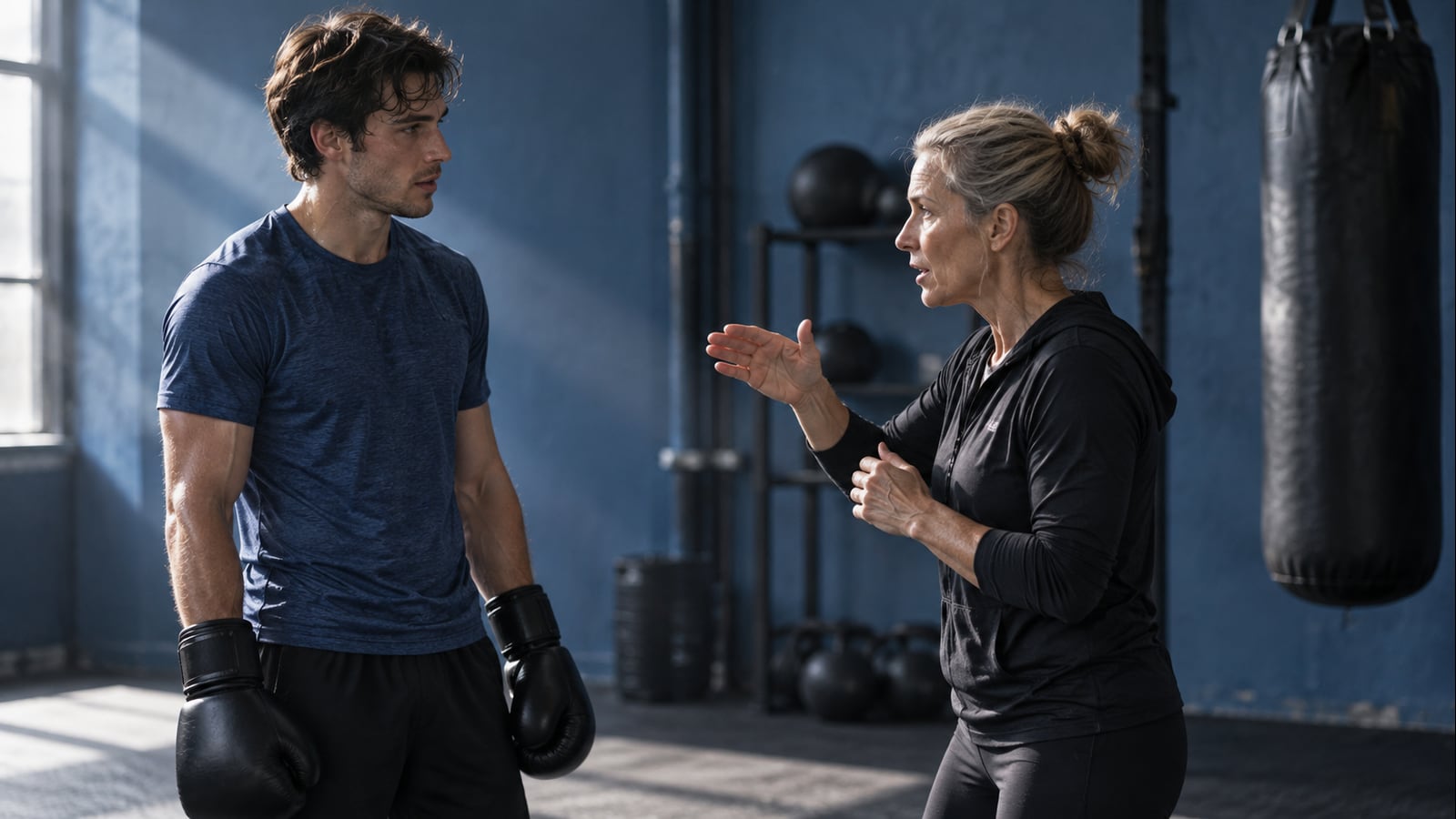
Ask for a bounded piece of help at an appropriate time: “After the demonstration, could you watch three attempts at this?” That is a more concrete request than “Can you teach me everything I’m missing?”
Try asking which session gives beginners technical feedback, or whether there is a quieter time for questions. A crowded class and the wrong class are different problems.
Being considerate does not mean accepting an arrangement where you never get instruction. If nobody can explain how beginners receive feedback, ask about a different session or consider another coaching setup.
Videos and apps can provide demonstrations and a practice structure. They should not be treated as an observation of your personal mistakes when nobody has actually watched you.
Do not let every new video change the assignment
Imagine your coach has asked you to stop losing balance after a punch. You spend the next practice session experimenting with five professional fighters’ stances instead. You worked hard, but you did not work on the agreed question.
Keep a “later” note for interesting ideas. Finish checking the current cue before promoting a new trick into the session.
Knockout provides technique videos and guided rounds. Use that structure to revisit familiar material, while asking a qualified coach to verify the correction you are trying to make. [2]
A better goal for your next class
Instead of “be less terrible,” choose: show my coach what I practiced and ask whether it changed the movement.
An answer of “not yet—adjust this” is still useful. You now have feedback on an actual task, not another reason to think you are failing at the entire sport.
Related questions
Which boxing skill should I improve first?
Ask your coach to choose from what they observe. Begin with the foundations needed for your current task, and address painful or uncontrolled actions before adding complexity. There is no single first correction that fits every beginner.
Should I work on one thing at a time in boxing?
Use one main cue when you are trying to correct a movement. That does not mean ignoring safety, abandoning the class plan, or doing only one skill forever. It means knowing what you are paying attention to during this attempt.
How can I improve if my coach has little time for me?
Ask a specific question and request a short observation when the coach is available. Also ask how the gym supports beginners. Solo work can reinforce an instruction, but it cannot solve an ongoing absence of meaningful feedback.
Do I need private boxing lessons to learn the basics?
Not automatically. First find out what instruction and correction the group sessions provide. A private lesson is one possible way to address a defined gap, not a requirement you must buy before attending a beginner class.
How long should I repeat the same boxing drill?
Use the coach’s instructions and keep checking the intended detail. Continue because the drill addresses a current need, not until a universal repetition count is reached. Ask for the next step when the task becomes controlled and repeatable.
Can watching boxing videos tell me what I am doing wrong?
A demonstration can give you a reference, but it cannot automatically identify your mistake. Describe what happens in your own movement, and seek qualified feedback. Avoid assuming that every error mentioned in a tutorial also applies to you.
Sources and editorial notes
[1] England Boxing, Boxing Coaching Handbook, Part 1, page 133: specific, limited coaching feedback.
[2] Knockout, official product website: technique videos and guided rounds.
The safety–control–polish decision aid, action–cue–check card, dialogue, and short practice example are original editorial suggestions. They are not a validated assessment or an official boxing curriculum.