The person next to you is making the bag crack across the gym. Your own round suddenly feels a little unimpressive.
Before you hit harder, ask a better question: what am I practising in this round?
A round for learning a punch, a sustained-work round, and a coach-directed power exercise have different purposes. There is no single power percentage this article can prescribe for all three—or for every boxer, bag, and hand.
The useful target is effort that fits the task while you can still follow the instructions. A louder impact is not enough information to judge that.
“Harder” can mean several different things
You can strike with more force, throw more punches, shorten the pauses, or continue for longer. Those are different changes. Keep them separate when you talk about intensity.
“I hit harder today” is vague. “I tried stronger single shots without adding more punches” tells your coach what actually changed.
A displayed punch count also does not tell the whole story. It cannot show whether the shots were controlled, whether the task was appropriate, or whether your hand hurt.
For your next session, choose one variable to discuss. Do not increase force, volume, and round length together just because yesterday felt manageable.
When the job is learning a movement
Keep the task simple enough to observe. That may mean familiar single punches or a short combination at an effort your coach has agreed with you.
Watch the technical cue you are practising: perhaps starting distance, a balanced finish, or bringing the hand back. Those are established parts of bag and basic punching instruction. [1][2]
When increasing force makes the cue disappear, reduce the demand and get feedback. You are not abandoning the exercise; you are returning to its purpose.
Imagine working on a jab that finishes in a good position. If the next harder attempt leaves you leaning against the bag, the extra force has not answered the original question.
When the job is sustaining work
Agree on a pace you can maintain for the planned exercise rather than opening with a burst you cannot repeat. A conditioning session can be demanding without every punch being a maximal effort.
Notice whether you are following the assignment or simply chasing exhaustion. These are different reports: “I completed the planned work,” “my technique became messy,” and “my hand started hurting.” Do not collapse all three into “good hard session.”
If the exercise becomes unmanageable, stop and adjust it with the person supervising the session. Do not use a timer as permission to keep striking through pain.
When the job really is power
Power work belongs in a defined exercise, not in every spare second between the bells. Ask your coach to set the task, observe your contact, and decide whether the equipment and your current technique suit it.
A useful instruction includes more than “go hard.” Which punch? What target and distance? How many attempts? What recovery? What would make the exercise stop?
Those details matter more than claiming you are at exactly 70 or 90 percent. Without an appropriate measurement, that number is a personal description—not a force reading or a safety limit.
This guide does not give a maximal-punching test. You do not need one to have a productive ordinary bag session.
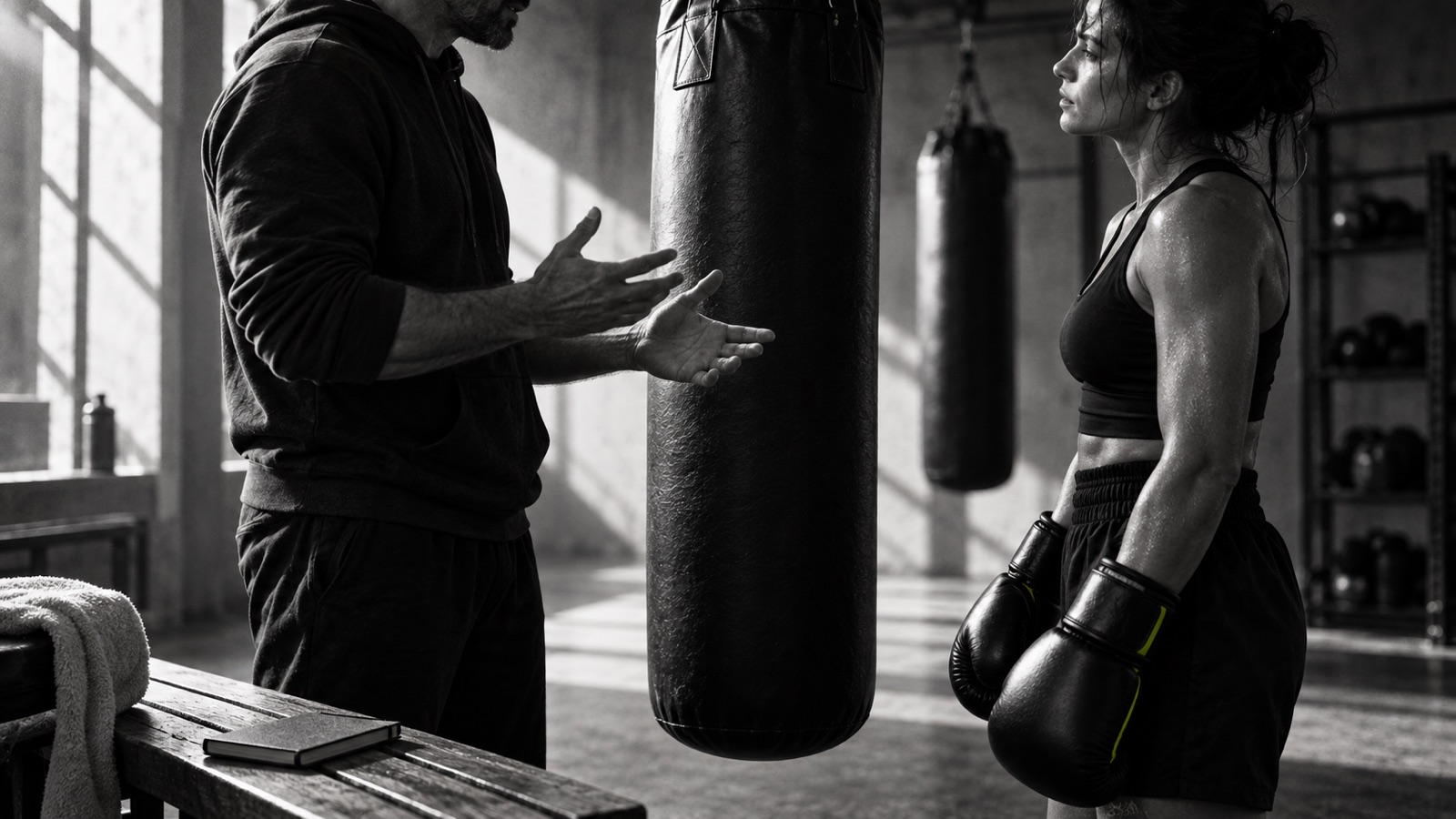
Check the setup before adding force
Use appropriate bag gloves and correctly applied hand wraps, and have a coach check your hand position and contact mechanics. Fran Sands’ heavy-bag guidance treats hand protection as a prerequisite, not an optional detail. Protection does not establish a safe intensity for an injured hand. [1]
Make sure the bag is properly installed and the surrounding space is clear. A coach or gym staff member should address an unfamiliar or questionable setup before you use it.
Do not lean on the bag to hold yourself up or chase it across the room because it swings. Reset the distance and the task. Bag movement is not a reliable standalone grade for your punching technique. [1]
If you have not learned how to make contact, start with instruction rather than harder trial-and-error punches.
Pain changes the decision
Sore or damaged knuckles are not a target to train toward. If punching causes hand or wrist pain, stop the contact work. Do not use more rounds to test whether the problem will warm up, toughen up, or disappear.
Pain can have different causes, and a description online cannot establish which one applies. The NHS advises against self-diagnosing hand pain and recommends medical advice when it worsens, recurs, or interferes with normal activities. [3]
A coach can inspect the exercise and equipment. A clinician assesses a possible injury. These are different jobs; a glove change is not a diagnosis, and a wrap is not clearance to continue.
Make the next round easier to evaluate
Before the bell, finish this sentence: “The purpose of this round is…” Keep the answer specific enough that you can review it afterward.
Afterward, note one technical observation and whether the agreed workload was manageable. A note such as “I kept reaching once the bag moved away” is more useful than “I need to hit harder.”
If pain interrupted the session, record that separately and follow appropriate medical advice before returning to impact. Do not count a pain-free moment later that day as automatic permission to test the bag again.
Your bag does not need to impress the neighboring boxer. It needs to serve the exercise you came to practise.
Related questions
Should every punch on the heavy bag be full power?
No. The effort should match the purpose of the exercise. Learning a movement, sustaining work, and supervised power practice are different tasks. Treat maximal effort as a deliberately coached choice, not the default setting for every round.
Is 50 or 70 percent power right for beginners?
This guide cannot validate a universal percentage. People estimate “percent power” differently, and a label does not assess technique, equipment, or injury. Ask for observable instructions: the task, pace, amount of work, and reasons to stop.
Should my knuckles hurt after hitting the bag?
Do not treat knuckle pain as a required sign of useful training. Stop painful impact and seek appropriate assessment, particularly for severe, worsening, recurrent, or function-limiting symptoms. More padding or a tighter wrap is not a substitute for understanding an injury. [3][4]
Do gloves and wraps mean I can hit as hard as I like?
No. Appropriate gloves and correctly applied wraps belong in bag preparation, but they do not evaluate your technique, establish a safe power limit, or make an existing injury safe to train on. Get the setup and contact checked before increasing demand. [1]
Does more bag swing mean I am punching better?
Not by itself. A moving bag does not tell you whether you completed the technical task. Review your distance, balance, contact, and finish with a coach rather than using swing or noise as the entire score. [1]
How hard should I hit when training alone?
Stay within contact work you have already been taught and can perform under an agreed plan. Do not introduce maximal attempts to discover your limit alone. If the technique or setup is unfamiliar, use non-contact practice until you can get instruction.
Sources and scope
[1] Fran Sands / MyBoxingCoach — The Heavy Bag – 5 Rules to Hit By!.
[2] England Boxing — Boxing Coaching Handbook, Part 1 (2022); pages 67, 68, 73.
[3] NHS — Pain in the back of the hand.
[4] NHS — Broken finger or thumb.
The examples and reflection prompts in this guide are general suggestions, not an individual assessment. Use qualified instruction for technical corrections and appropriate medical care for symptoms or injuries.