An outside lead foot can change the angle for your rear hand. It does not settle the exchange. Learn what the position gives you, what it leaves open, and how to explore it without contact.
You have heard the cue: “Get your lead foot outside theirs.” Then you watch an experienced boxer spend time on the inside, circle the other way, and still find good positions.
The cue is useful. The missing part is its purpose.
When an orthodox boxer faces a southpaw, the feet, lead hands, and rear-hand lines meet differently. Start by understanding that relationship. You do not need a new stance or a collection of professional tricks.
If you are still deciding which stance to learn, start with orthodox or southpaw (https://www.knockoutboxing.app/learn/orthodox-or-southpaw/). This guide is about facing someone whose stance is opposite yours.
Get the directions straight
Orthodox usually means left hand and left foot forward. Southpaw usually means right hand and right foot forward. In an opposite-stance matchup, the lead feet occupy neighbouring lanes and the lead hands meet more directly.
“Outside” describes the relationship between those lead feet:
- An orthodox boxer seeks the outside position by moving their left lead foot to their own left of the southpaw's right lead foot.
- A southpaw seeks it by moving their right lead foot to their own right of the orthodox boxer's left lead foot.
Left and right here always mean the boxer's own left and right. A video filmed from the other side can make a verbal instruction seem reversed.
Use this as a floor-map description, not a demand to stare at shoes during boxing.
Why coaches teach the outside position
A modest outside step can help align your rear straight while moving you away from the opponent's original rear-straight line. Boxing Federation of India coaching material uses this relationship when discussing an orthodox boxer's approach to a southpaw. [1]
The important word is “can.” The opponent can turn, adjust distance, change the punch, or move their feet too. Your head and shoulders also matter. Getting a toe outside while leaving your upper body in the same place has not automatically solved the problem.
Ask three questions after the step:
- Am I still at a useful distance?
- Can I move again without rebuilding my stance?
- What attack or exit was this position meant to support?
If you cannot answer the last question, you may be collecting a position instead of using one.
Keep both feet in the discussion
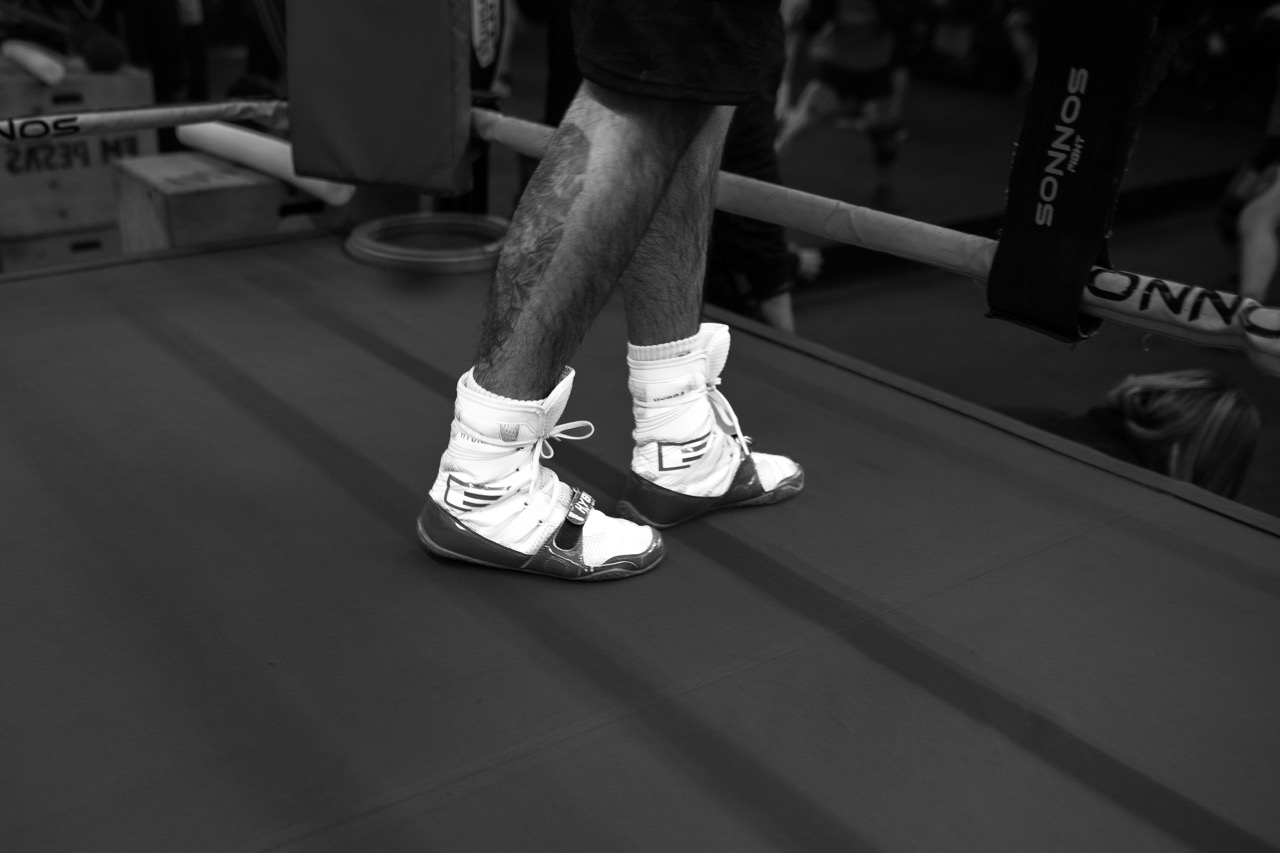
A common mistake is reaching sideways with the lead foot while leaving the rear foot behind. The front shoe reaches the desired spot, but the stance becomes too long or wide to use comfortably.
England Boxing's coaching guidance emphasises keeping a usable base while changing distance and direction. [2] Let that govern the size of your step. A smaller angle you can stop in is more useful for beginner practice than a dramatic stretch.
Do not deliberately stand on a partner's foot, turn the exercise into a shoving contest, or keep moving through tangled feet. Stop and reset.
Why “always circle this way” falls short
Circling towards the outside of the opponent's lead foot is a helpful starting idea. It often takes a southpaw to their right against an orthodox boxer, or an orthodox boxer to their left against a southpaw.
But a circling direction and a safe position are not the same thing. Distance, timing, the opponent's turn, and your guard affect what happens next. A wide circle can surrender useful space. A predictable circle can be anticipated. The ropes may remove the exit you planned.
An experienced boxer moving the other way may be working with a particular read or setup. A short clip rarely explains all of it. You cannot tell from the direction alone whether copying the movement is a sensible beginner task.
Bring a specific question to your coach: “When I move this way, which line am I entering, and what should my next position be?” That creates a much better lesson than arguing over whether left or right is always correct.
Remember the lead hands
You can obsess over your feet while forgetting the hands closest to each other. The jab, guard, and small changes in distance still need attention.
Keep your lead hand available. Avoid reaching it far out and leaving it there just because you saw an elite boxer use an extended guard. Ask your coach to connect the foot position to a familiar jab or rear straight on pads, with a clear recovery afterwards.
The useful sequence is simple: recognise the relationship, make a small adjustment, perform the assigned action, and finish organised. You do not need to add prolonged hand fighting or a new defensive system to understand the angle.
Try a three-part, no-contact practice
These are observation and coordination tasks. Warm up normally, use a clear non-slip area, and keep the pace comfortable.
1. Map it. Put a flat tape mark on the floor to represent the other boxer's lead foot. Stand well back, picture the opposite stance, and identify your inside and outside directions. Take one small step and restore your normal base. Do not punch towards a person.
2. Add the rest of the stance. Repeat with your hands in guard. Pause after every step. Check whether you can move back to the starting position without crossing your feet or dragging your balance after you. If the step keeps stretching you, shorten it.
3. Give it a purpose. With your coach, use pads or a no-contact positioning drill to connect one angle to one familiar action and a reset. The coach should set the distance and task. Stop if feet collide or the exercise turns competitive.
Keep each part short enough to stay attentive. This is not a race for outside position, and it does not require sparring.
Common questions
Is the inside foot position always wrong?
No. It changes the available lines and responsibilities. Beginners should understand it with a coach rather than treating either position as automatically winning or losing.
Should a southpaw always circle right against orthodox?
It is a common starting cue, not a complete tactical rule. The useful question is what that direction does to distance, alignment, and the next exchange.
Should I look down to check the feet?
Use slow, paused learning drills to understand the layout. During boxing, keep attention on the opponent instead of repeatedly dropping your eyes to confirm a shoe position.
Should I switch stance to avoid the problem?
Do not make stance switching your first solution. Keep the stance you are learning and ask your coach to simplify the opposite-stance task.
Practise the angle, then the action
Take one question into your next class: “Can you show me how this foot position changes my rear-hand line and my exit?”
Between classes, use simple shadowboxing rounds (https://www.knockoutboxing.app/learn/how-to-shadowbox/) or guided practice in Knockout to rehearse the movement your coach has checked. Save the unpredictable partner work for properly supervised training.
Sources and scope
1. Boxing Federation of India: Strategy Against Southpaw Boxer (https://boxingfederation.in/wp-content/uploads/2020/04/Strategy-Against-Southpaw-Boxer.pdf), Raffaele Bergamasco, opposite-stance alignment.
2. England Boxing Level 2 Coaching Handbook (https://www.englandboxing.org/wp-content/uploads/2022/03/Level-2-Coaching-Handbook-compressed.pdf), footwork principles, printed page 78.
3. AIBA Coaches Manual, hosted by IBA (https://www.iba.sport/wp-content/uploads/2018/07/AIBA-Coach-Regulations-Manual_WEB.pdf), stance and directional steps, printed pages 33–39.
Checked October 8, 2026. The floor-map explanation and no-contact practice sequence are editorial teaching suggestions built around basic positioning principles, not a federation-prescribed drill or a guarantee of defensive safety. Contact training requires a qualified coach, agreed tasks, and appropriate supervision.