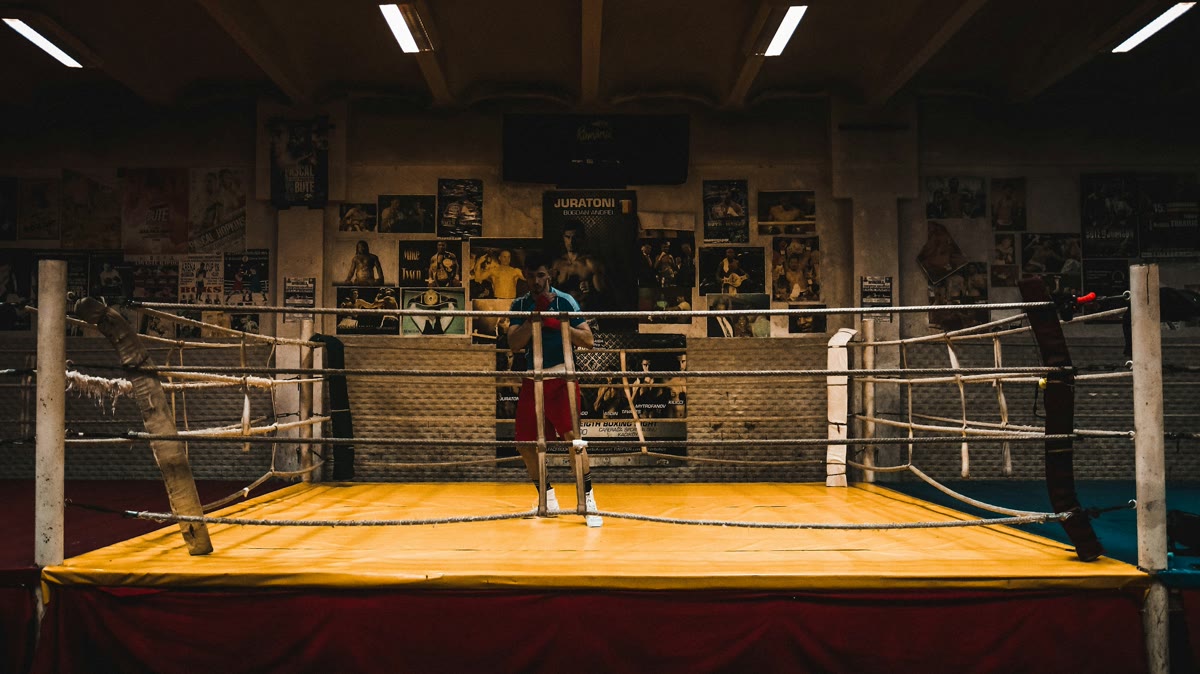
You would like to start boxing. What you currently have is a room, a phone, and no idea whether that is enough to do anything useful.
You can begin non-contact boxing practice without a bag or specialist equipment. Shadowboxing, for example, rehearses boxing movements without a physical opponent or impact target. But practising alone is not the same as having your technique assessed or learning to spar. [1]
That distinction gives you a sensible starting point: learn something small, give yourself room to practise it, and know which questions still need feedback.
You do not have to solve your entire boxing future before beginning.
Your first piece of equipment is clear space
Before following a workout, check the place where you will move. You need room for the action you are practising—not just enough space to stand still.
Move furniture and breakable objects out of reach. Check the floor for slipping or tripping hazards and the ceiling for anything your hands might hit. Keep children, pets, cables, and other people outside the practice area.
Place the phone on a stable surface beyond your movement space. Watch the demonstration, pause it, and then practise. Do not chase the screen around the room or hold it while you punch.
If you cannot move without reaching toward a wall, shorten the task to watching or choose another location. A cramped setup does not become suitable because the video says “no equipment.”
Pick the starting point that matches you
Never had a boxing lesson? Begin with understanding the demonstration: which foot is forward, which hand is the lead hand, where the guard starts, and where the person is looking. Follow one clearly explained beginner source rather than mixing five incompatible clips.
Already attending classes? Repeat a small, non-contact task your coach has taught you. A familiar correction gives the practice a purpose and gives you something to check at the next lesson.
Waiting for your first class? You can prepare questions and build a manageable exercise habit without trying to teach yourself the whole sport first.
These are different situations. You do not need the same routine as someone who has already spent months learning the movements.
Start with a learning task, not a punishment workout
Choose one beginner demonstration that shows the whole body and explains its starting position. Basic coaching instruction begins with a stance and guard before adding more complicated actions. [2]
Watch once without moving. Then describe the task in plain language: “This lesson is showing me the starting position,” or “This is a small step from that position.” If you cannot tell what the lesson is asking, replay or choose a clearer introduction.
A concrete first task: after a stance-and-stepping demonstration, practise one small forward movement and one back in the position shown. Notice whether your feet finish spaced apart rather than touching or crossing. Pause and reset between attempts. Keeping the base organized is a basic footwork coaching point. [2]
End with one observation: what you understood, what felt unclear, and what you would ask a coach. That is a real learning task even when it does not leave you exhausted.
This is an editorial starting exercise, not a substitute for technical instruction or a test of boxing ability.
No bag means no impact—not a homemade target
You do not need to invent something to hit. Shadowboxing has a different purpose from bag work; the absence of a target is part of the activity. [1]
Keep walls, doors, furniture, and improvised hard surfaces out of it. Do not ask a friend to absorb punches or hold a makeshift target while you discover your contact technique.
Likewise, gloves do not create a reason to strike something unsuitable. They are not needed for the non-contact observation task above, and owning them does not mean you have learned how to land a punch.
If you later add a bag, treat that as a new setup and a new skill: suitable installation, appropriate protection, and instruction in contact mechanics—not simply the same home routine performed harder.
What can you do before joining a gym?
Build a small amount of physical activity you can manage consistently. The CDC recommends starting at a suitable level and building gradually; activity does not need to happen in one long session. Existing health conditions may require advice about suitable exercise. [3]
Walking and familiar bodyweight exercises are possible components, depending on your circumstances and technique. General activity and muscle-strengthening work have different roles; neither teaches boxing timing by itself. [4]
There is no push-up total or running distance you must achieve to deserve a beginner lesson. Ask the gym what its introductory class involves and whether it can accommodate your current level.
The useful preparation is arriving with a realistic description of your experience and any relevant limitations—not exhausting yourself to prove you belong.
Get feedback when access is difficult
A video can show you a movement; it cannot see what you did afterward. Keep that distinction in mind when choosing online material.
Look for clear demonstrations, explanations of common mistakes, and an identifiable instructor. Treat promises of fighting ability from a short unsupervised course cautiously.
When in-person access is limited, an occasional lesson or a qualified coach reviewing an agreed short recording may be worth exploring. Availability and cost will vary; this article does not assume those options exist nearby.
Ask what a review actually includes before paying. Can the coach see your whole movement? Can you ask follow-up questions? Are they commenting on a simple non-contact task, or claiming to assess abilities the recording cannot show?
Keep recordings private unless you choose otherwise, and avoid filming other people without permission.
Know what solo practice cannot clear you for
A practiced combination in an empty room does not establish how you will respond to another person. It also does not establish that you are ready for sparring, competition, or a confrontation.
Do not turn progress at home into a reason to try unsupervised contact. Readiness, matching partners, and supervising the session belong with qualified coaching and the appropriate safety requirements.
Home practice can still have a modest, useful goal: you understand the lesson better, can repeat an instructed non-contact task, and have a clearer question for your next opportunity to get feedback.
Use guidance to remove the guessing
When choosing your next session is the obstacle, a guided option can help organize the task. Knockout offers beginner-focused plans, technique videos, guided rounds, and a built-in timer; its own guidance also distinguishes solo practice from coaching for sparring or technique correction. [5]
Start with an appropriate introductory lesson rather than the most intense workout. Pause to understand a movement and keep the practice within the space and experience you actually have.
An app can tell you what comes next in the session. It should not make you think your form has been checked when it has not.
Related questions
Can I start boxing without any equipment?
You can start non-contact practice such as learning a basic position or shadowboxing with suitable instruction and enough clear space. You cannot recreate every part of boxing that way. Impact work, partner practice, and readiness for contact require additional setup and guidance. [1]
What should I practise before my first boxing class?
You can become familiar with basic terminology, watch a clear beginner demonstration, prepare questions, and build manageable general activity. You do not need to arrive with a self-taught full skill set. Ask the gym what its first session expects. [3]
Can I shadowbox in a small room?
Only when there is enough unobstructed space for the specific movements. Check your reach, floor, ceiling, and nearby objects. Adapt or postpone the movement rather than hitting a wall, tripping over furniture, or trying to keep up with a routine your room cannot accommodate.
Do I need gloves for shadowboxing at home?
Not for the unloaded, non-contact practice described here. Keep the activity genuinely non-contact. Adding gloves does not make furniture a suitable target or replace instruction in safe equipment use and impact technique.
Can I learn to box completely on my own?
You can learn terminology and rehearse movements, but learning alone leaves important feedback and partner-interaction gaps. Do not use a completed video course or home routine as evidence that you are ready to spar, compete, or handle a confrontation.
Can a boxing app replace a coach?
An app can provide demonstrations and session structure. That is different from a qualified person observing you, correcting your technique, and supervising contact practice. Use each for the job it can actually do; Knockout also makes this distinction in its product guidance. [5]
Sources and scope
[1] Fran Sands / MyBoxingCoach — Shadow Boxing – 7 Tips for Success.
[2] England Boxing — Boxing Coaching Handbook, Part 1 (2022); pages 67, 68, 73.
[3] Centers for Disease Control and Prevention — Adding Physical Activity as an Adult.
[4] Centers for Disease Control and Prevention — What Counts as Physical Activity for Adults.
[5] Knockout — Learn boxing with a plan.
The examples and reflection prompts in this guide are general suggestions, not an individual assessment. Use qualified instruction for technical corrections and appropriate medical care for symptoms or injuries.