You step in, they step out. You reach a little farther, lose your shape, and still end up at the end of their jab.
Against a taller boxing partner, start with the distance problem—not a promise to punch harder or rush inside. Work with your coach on recognizing range, creating an opportunity to enter, and knowing what to do after you arrive. Reaching for a distant head is not the same as closing distance with control. [1][2]
The goal of a learning session is to understand that problem. It is not to prove you can absorb punishment from someone bigger.
Height is a clue, not a complete scouting report
Do not assume that “taller” automatically means the same thing as “longer reach,” “slower feet,” or “weak on the inside.” They are different characteristics, and the label alone does not establish how this person boxes.
Observe the task in front of you with your coach. Does your partner retreat when you approach, hold their position, or advance? Do they answer your jab, or use their own first? Those questions tell you more about what to practise than copying a famous short boxer.
A useful first description is: “I am having trouble reaching this target while staying in position.” That is more precise than “I cannot box tall people.”
Separate reaching from entering
Reaching asks your upper body to find a target your position has not made available. Entering asks how your feet, guard, and action work together to put you somewhere useful.
Fran Sands warns against overcommitting weight while trying to make the jab hit harder, and his footwork guidance treats movement as a way to manage distance. Those are relevant foundations before discussing a shorter-versus-taller matchup. [1][2]
Ask your coach to watch what happens when the target moves away. Do you keep your stance and reconsider, or stretch forward because you already decided the punch must land?
Try this question before your next appropriate drill: “Where should my feet be when this target is actually available?” Have the coach demonstrate, then check the movement without contact. Do not use the head of a sparring partner to discover that your reach estimate was wrong.
Your jab still has a job
A shorter boxer does not need to abandon the jab just because a partner can reach a target from farther away. The question is how to use it within the distance you can manage.
Sands describes the jab as a tool for initiating an attack and controlling an exchange, rather than only a power punch. [1] In coached practice, discuss its role: are you checking whether the target is available, beginning a taught entry, or looking for a response?
Those are different jobs. A jab that cannot reach a particular target from your current position is not a failed version of the same punch from an appropriate distance.
Avoid the obvious trap: trying to win a reach contest without changing the situation. Ask your coach whether your jab needs a coordinated step, a different setup, or simply a decision not to throw yet.
Three entry ideas to discuss—not three guaranteed answers
The examples below organize a coaching conversation. They are not combinations to test at full speed, and they do not authorize contact practice without appropriate supervision. Use movements your coach has already taught and checked.
Enter behind a familiar action. Ask how an action and a step should work together in your stance. In a non-contact demonstration, have the coach show the starting distance and the finish. Your question is not merely “Did I get closer?” but “Can I still see, move, and recover my position?”
Create a response before trying to enter. A feint is a suggestion of an action, used to see or encourage a response. Sands' taller-opponent material presents a feint, the opponent's reaction, and a defended entry as one tactical option. That is one coach's approach—not a guarantee that a particular person will react as expected. [4]
Ask your coach to demonstrate one familiar cue and response. Discuss what happens when the response does not occur. A feint that receives no useful response is not an instruction to charge anyway.
Let the other boxer cover some of the distance. Chasing is not the only possible setup. Sands also discusses drawing a taller boxer forward rather than always pursuing them. [5] That option still depends on your ability to recognize the approach and use an appropriate defense; standing still and inviting punches is not the exercise.
Choose one idea to explore with the coach. Stacking all three into a busy sequence can make it harder to identify why an attempt worked or failed.
Getting inside is the beginning of another task
Suppose you solve the entry but then stand in a position where you do not know what to do. You have not finished the learning problem; you have moved to a new one.
Ask your coach what the next task is at that distance. Which action have you been taught there? Where should your guard be? How do you recognize that the opening has gone? Which reset fits the agreed exercise?
Do not assume a taller partner becomes ineffective just because you are closer. The appropriate next action depends on both boxers and the position, not a rule that shorter always wins inside.
For an introductory learning task, arriving balanced and leaving as agreed may be enough to practise. There is no requirement to add hooks, uppercuts, or a clinch you have not been taught simply because you managed to get closer.
Make the reset part of the entry
Before trying an entry, answer: “Where do I intend to finish?” Include that answer in your discussion with the coach.
You might be practising a return to the starting distance, recovery of stance after an action, or a coach-taught change of position. Do not select a universal direction from an article; stance, space, and what the partner does all change the problem.
A failed entry also needs a reset. If your partner moves away, do you keep chasing because the plan says “get inside,” or recognize that the opportunity has changed?
Stopping the attempt is not necessarily a tactical failure. For this learning goal, a controlled decision not to overreach may be exactly the observation worth taking into your next practice.
Use a range-observation exercise before adding pressure
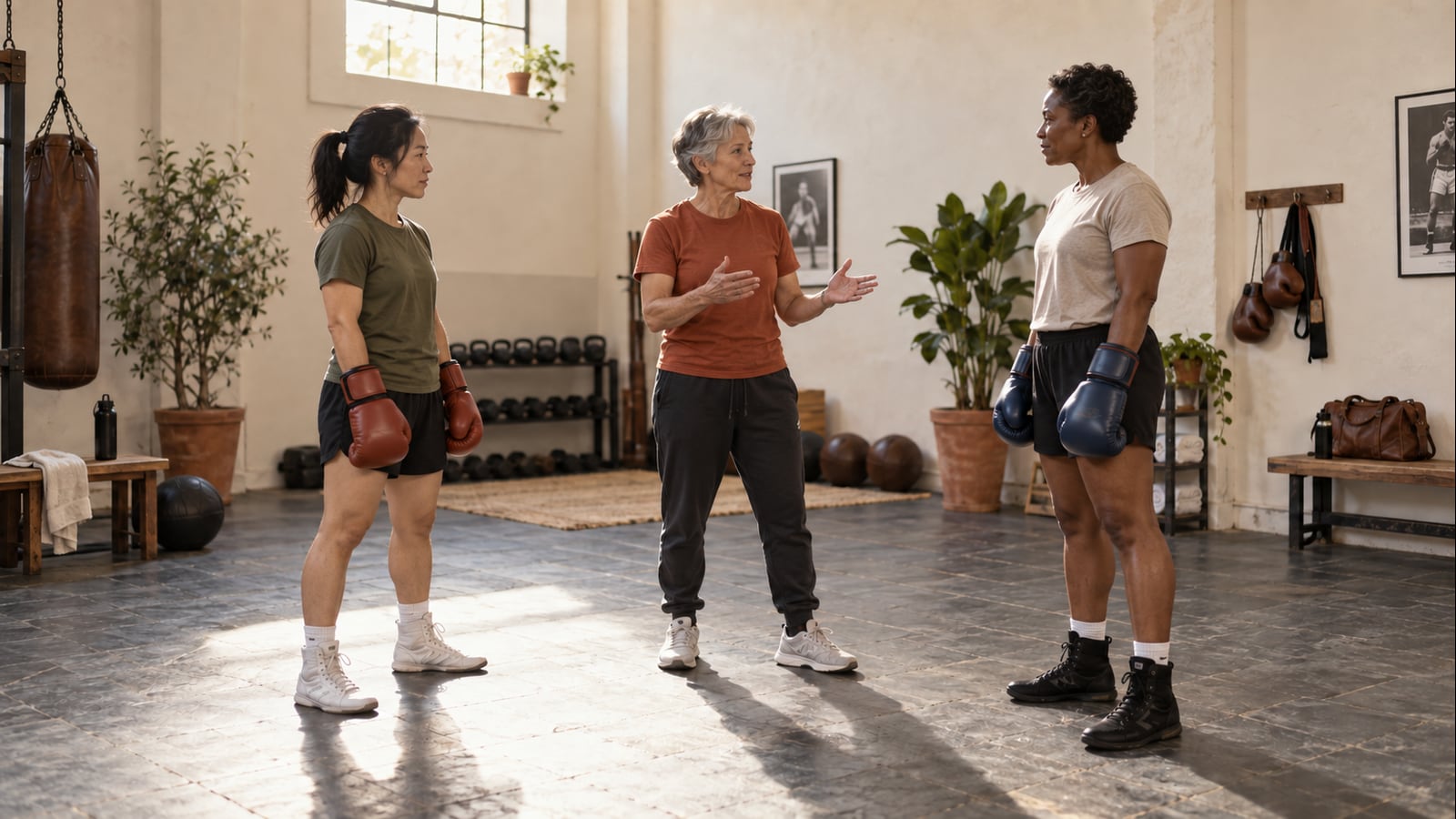
Ask your coach about a cooperative, non-contact task with a pad target. The coach can choose an appropriate starting distance, show a small change, and ask you to identify whether the target is available from your current stance.
Start by describing what you see. Then rehearse a familiar adjustment only when the coach asks for it. The purpose is to connect your estimate with their feedback—not test speed or take turns surprising each other.
This is an editorial example, not a validated training protocol. The coach should adapt or replace it for your level. It should not turn into sparring halfway through because either person gets bored.
Afterward, write down the error you actually noticed: reaching, starting too far away, losing the target, or arriving without a reset. That is a more useful next-session question than “How do I beat tall boxers?”
Use solo training for the movement, not the matchup
Knockout can support fundamentals rehearsal between coached sessions. It cannot reproduce a taller opponent's choices or verify your entries. Use independent practice for an appropriate movement your coach identifies, then return for feedback. [6]
Related questions about boxing taller opponents
Can a shorter boxer use the jab effectively?
Yes—the jab does not stop having a role because the other boxer is taller. Work with your coach on the distance and purpose of the action. Do not confuse a target being unavailable from one position with the punch being useless. [1]
Should I always try to get inside against someone taller?
No single plan follows automatically from height. Discuss the partner's behavior, your available skills, and the session's purpose. Getting closer also creates another technical task; it is not a guarantee that the matchup becomes easy.
How do I stop reaching when the opponent moves away?
Ask your coach to compare your position before and after the attempt. Rehearse recognizing when the target is no longer available and using an agreed adjustment or reset. Avoid making the punch land by sacrificing the balance you were supposed to maintain. [1][2]
Is slipping the jab always the best way to get inside?
No defense or entry fits every exchange. A slip requires an appropriate cue, direction, timing, and position; it is not a universal instruction to duck whenever someone taller moves. Practise the response your coach selects in controlled conditions.
Do I have to take punches to close the distance?
Do not adopt getting hit as the price of practising an entry. Discuss a protected approach and a reset with your coach. When the exercise becomes unmanageable or the contact exceeds the agreement, stop rather than trying to earn your way inside.
Can I learn this matchup from shadowboxing alone?
You can rehearse familiar steps and actions, but you choose what the imaginary opponent does. Use shadowboxing to prepare a movement, not prove you can read an actual partner. Matchup decisions need qualified coaching and appropriately managed partner practice.
Sources and scope
The questions behind this guide come from Knockout’s saved Reddit research. Coaching and safety claims were checked separately against the sources below. The sample questions, worksheets, and practice examples are editorial suggestions—not tested protocols or individual clearance to take part in contact boxing.
[1] Fran Sands / MyBoxingCoach. The Boxing Jab — Get Control with the Perfect Punch!.
https://www.myboxingcoach.com/punching-how-to-throw-a-jab/
[2] Fran Sands / MyBoxingCoach. Footwork — Moving In and Out.
https://www.myboxingcoach.com/footwork-moving-in-and-out/
[3] England Boxing. Boxing Coaching Handbook, Part 1. Coaching principles and specified technique faults only; use current rules for eligibility and equipment.
https://www.englandboxing.org/wp-content/uploads/2022/03/EB_Boxing-Coaching-Handbook-Part-1_v8-002.pdf
[4] Fran Sands / MyBoxingCoach. Beating a Taller Boxer with a Killer Strategy.
https://www.myboxingcoach.com/beating-a-taller-boxer-with-a-killer-strategy/
[5] Fran Sands / MyBoxingCoach. 3 Tips to Beat a Tall Boxer.
https://www.myboxingcoach.com/3-tips-beat-a-tall-boxer/
[6] Knockout. Knockout — Boxing Training.
https://www.knockoutboxing.app/