“Use your jab” sounds clear—until you are in front of someone who keeps moving, answering, and making the next step less obvious.
A simple boxing sparring game plan should name one situation, one familiar response, and what you do afterward. Build it with your coach around a learning goal and the session's agreed conditions. It is not a script that guarantees you win the round.
You do not need a complicated identity—pressure fighter, counterpuncher, slick outside boxer—before you can enter practice with a purpose. Start with a problem small enough to notice.
Give the round a job
Try replacing “I want to do better” with a question your coach can observe. “Can I finish my jab in position to move?” is a question. “Can I recognize when I am reaching for a target that is too far away?” is another.
Choose something that fits your current skills. An elaborate plan built around a defense you have never learned is a request for confusion, not evidence of ambition.
Coach Fran Sands describes tactics as choices that put a broader strategy into practice, with the choice depending on the boxer and the situation. Use that distinction to make your plan smaller and more specific. [1]
For a learning round, the goal is to find out whether a decision works under the agreed conditions—not prove that your favourite style is correct.
Write your plan in three lines
Use this original worksheet with your coach. It is deliberately short enough to remember without reciting a paragraph between exchanges.
Notice: What situation tells me there is a decision to make?
Act: Which familiar action am I practising in that situation?
Reset: Where should I finish, and what will I look for again?
For example: “Notice when my partner leaves the distance we agreed. Avoid reaching; use the range adjustment my coach taught. Finish balanced, then reassess.” The coach needs to supply and check the actual movement, not just approve the words.
A game plan needs this ending. Otherwise, you may spend the whole session asking how to start an exchange without deciding what happens after your first action.
England Boxing's coach-development work has used the theme of what a boxer does before and after punching. That is a useful reminder to plan more than the punch itself. [2]
Example one: your combination never seems available
Imagine you enter every round determined to throw the same three-punch combination. Your partner keeps moving before it is available. You keep trying anyway, and the session becomes a chase.
Here is a different question to take to your coach: “What would I need to notice before this combination makes sense?” Ask them to demonstrate the relevant distance or response without contact first.
Your learning plan might then become recognizing the opening and deciding whether to begin—not forcing all three punches regardless of what changes. Agree on the permitted task and a clear reset when the opening is absent.
Afterward, review your decisions. Did you recognize a genuine opportunity, miss one, or start because you had memorized what you wanted to do? All three answers are more useful than counting how many times you completed the combination.
Example two: you stop after your own punch
Perhaps your jab is not the main problem. You use it, watch it, and then have no idea what comes next.
Ask the coach to make the finish the subject of a controlled task: “After this action, can we work on returning to the position you want?” Use a finish you have already learned, not a new evasive move selected from a highlight reel.
Your three lines could be: “Notice that my action is finished. Recover the agreed position. Look again before choosing another action.” The point is to break the assumption that throwing a punch completes the job.
Judge the attempt by its purpose. Landing a touch while forgetting the finish may be less relevant to this learning task than a clean, controlled attempt followed by the intended reset.
Example three: the other boxer keeps rushing forward
First distinguish a tactical question from a conditions problem. If the partner is ignoring agreed limits, escalating contact, or leaving you unable to defend, stop and involve the coach. You do not owe them a clever answer while the agreement is being broken.
In an appropriately controlled task, ask your coach to identify what the forward pressure actually does. Does your partner advance behind a jab? Follow you in a straight line? Close the distance after you pause? “They rush me” may describe several different situations.
Sands' material on managing a shorter opponent includes distance control, the jab, and changes of angle as possible tools. These are examples for particular matchups—not universal answers to anyone moving forward. [3]
Do not assemble them into an improvised survival combination. Choose one response your coach considers suitable and rehearse it in conditions where both partners understand the job.
Decide what counts as a reset
A reset is your agreed way to return to a situation you can read. Depending on the task, that may mean recovering stance, re-establishing the practice distance, or pausing while the coach clarifies something.
It is not an instruction to run away indefinitely, hold on regardless of the rules, or fire back harder because the first plan failed.
Ask: “When this situation stops looking like the one we practised, what should I do?” The answer should stay inside the session agreement and your current ability.
A planned pause can be especially useful during technical work. There is no need to pretend every drill has to continue as if it were a bout. Clarifying a misunderstanding is part of practice, not cheating at it.
Change one useful detail, not your entire identity
Suppose the coach observes that you are recognizing the right moment but starting from too far away. The next adjustment should address that observation. You do not necessarily need a new stance, a different style, and six more combinations.
Ask for one change and a way to notice it. For example: “How will I recognize the distance you want before beginning?” Then repeat an appropriate task under the coach's direction.
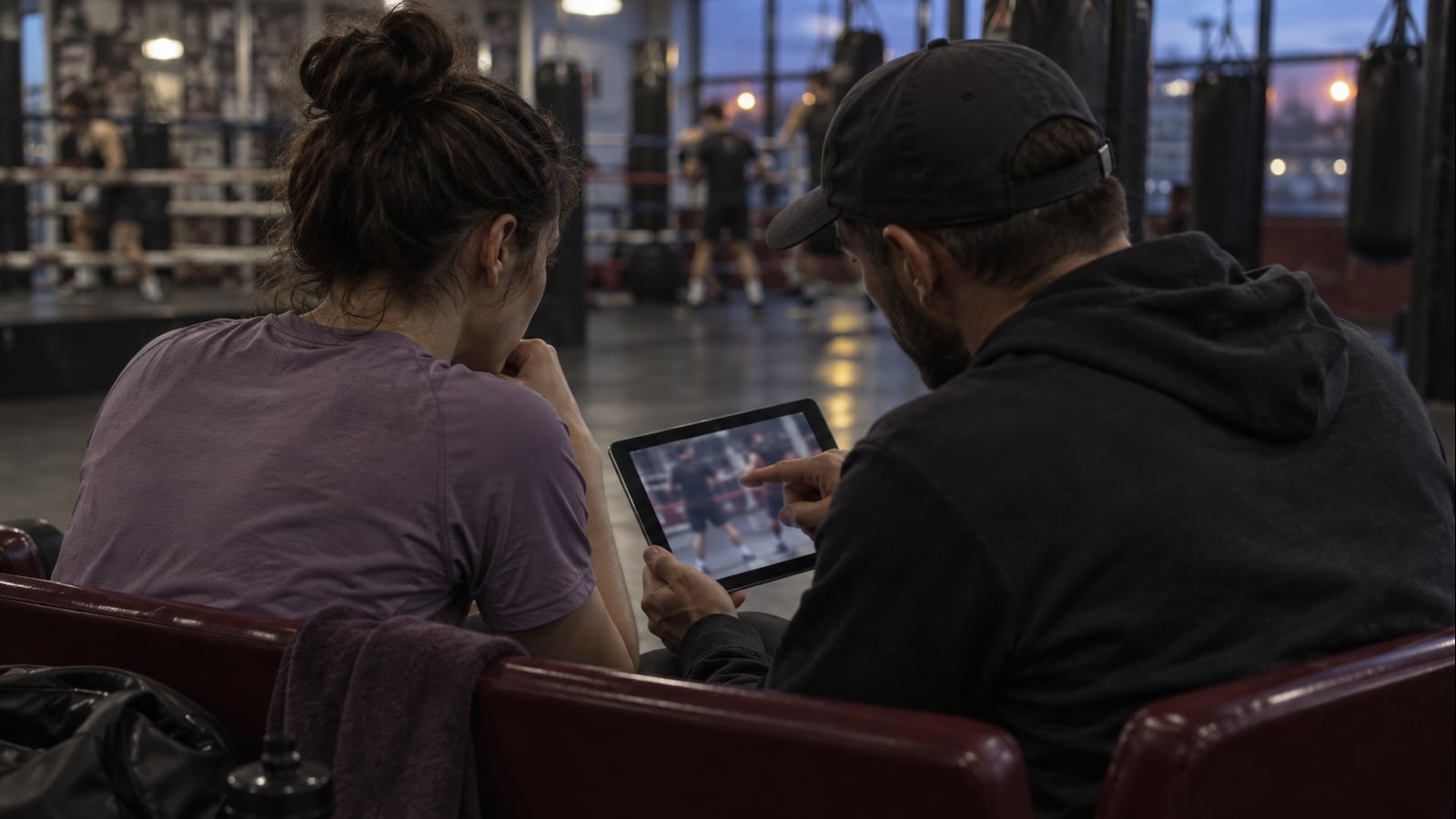
England Boxing has documented a workshop in which coaches reviewed recorded sparring, discussed tactics, and applied their observations in further practice. Use that feedback loop as a model for discussion—not a promise that any one adjustment must work. [4]
Take a useful note home
After the session, write the plan you attempted and one observation. Keep those separate from whether you felt pleased with the round.
An example: “My plan was to recognize the entry and reset afterward. I noticed the entry but forgot the reset when the pace changed. Next time I will ask to isolate that finish.”
That gives your next session a starting point. “I need to be more aggressive” leaves much more unexplained.
Knockout can support solo fundamentals practice between coached sessions. Use it for a suitable movement your coach identifies; it does not select tactics for a live opponent or supervise sparring. [5]
Related questions about sparring strategy
What is a simple game plan for a beginner boxer?
Agree with your coach on one situation to notice, one familiar action, and one reset. Keep it within the purpose and limits of the session. The plan should be simple enough that you can describe afterward what happened and what needs attention.
Is a game plan just a list of combinations?
No. A combination describes a sequence of actions. A useful plan also identifies when that sequence is appropriate, what you will do when it is unavailable, and how you finish. Practising the decision is different from memorizing more punches.
What should I do when someone rushes me?
Stop first if the situation violates the agreement or you cannot defend. For a genuine tactical practice question, ask the coach to identify the kind of forward pressure and teach one appropriate response. No single move answers every version of a rush.
Should I decide my boxing style before sparring?
You do not need a fixed label to practise a clear task. Start with skills you have been taught and observations about the situation. Treat style descriptions as conversation tools, not rules that force you to behave the same way against every partner.
How often should I change my game plan?
Change it for a reason you and your coach can identify, rather than after every frustrating exchange. During learning tasks, narrow adjustments are easier to discuss. Immediately stop or modify the session when conditions or safety require it.
Can shadowboxing help me rehearse a game plan?
It can help you remember a familiar action and its finish. You are still supplying the imaginary cues yourself. Use solo rehearsal to prepare for coach-led feedback, not as evidence that the same plan will work against a responsive opponent.
Sources and scope
The questions behind this guide come from Knockout’s saved Reddit research. Coaching and safety claims were checked separately against the sources below. The sample questions, worksheets, and practice examples are editorial suggestions—not tested protocols or individual clearance to take part in contact boxing.
[1] Fran Sands / MyBoxingCoach. Ten Fight Tactics for Winners.
https://www.myboxingcoach.com/ten-fight-tactics-for-winners/
[2] England Boxing. Women’s Coach Development Programme: Coaches Take on Sparring Masterclass.
https://www.englandboxing.org/news_articles/womens-coach-development-programme-coaches-take-on-sparring-masterclass/
[3] Fran Sands / MyBoxingCoach. How to Fight a Shorter Opponent.
https://www.myboxingcoach.com/how-to-fight-a-shorter-opponent/
[4] England Boxing. Sparring and Strategy: Women’s Coach Development Programme Hosts Hands-on Workshop.
https://www.englandboxing.org/news_articles/sparring-and-strategy-womens-coach-development-programme-hosts-hands-on-workshop/
[5] Knockout. Knockout — Boxing Training.
https://www.knockoutboxing.app/