A tennis ball drops. You catch it. Nice reaction—but it has not told you whether you can recognize a jab, choose a defense, and stay in position for what follows.
To work on boxing reactions beyond open sparring, separate three jobs: rehearsing the movement, noticing a boxing cue, and choosing a response. Solo practice can address the first. Coach-led work with a partner adds information you did not create yourself. Neither is a shortcut to being impossible to hit. [1][2]
The useful question is not just “How fast can I react?” It is “What am I reacting to, and what am I trying to do?”
Give the drill a real question to answer
Imagine two practice tasks. In one, you slip left whenever a timer beeps. In the other, a coach presents a controlled boxing cue and asks you to recognize it before using a defense you already know.
The first tells you that you can connect a sound with a rehearsed movement. The second asks a different question: can you connect relevant information with the right response? Do not treat the score from one task as proof you have solved the other.
Coach Fran Sands distinguishes reactive defensive drills from proactive movement used to create a response. His boxing-drills material also separates solo rehearsal from work requiring a partner. That is a useful distinction when choosing what your practice is actually for. [1]
Before adding anything, finish this sentence: “This drill helps me notice ___ and respond with ___.” When both blanks are vague, more speed will not make the purpose clearer.
Start with a defense your coach has checked
Choose one familiar action: a coach-taught hand defense, a step out of range, or an appropriate slip. Do not combine an unfamiliar movement with a surprise attack and then interpret the result as a test of courage.
England Boxing's handbook gives precise faults for hand defenses: reaching too far, making an unnecessarily large parry, and failing to return the hand to guard. Those are movement problems a coach can identify before you add more decisions. [3]
A useful request is: “Can you check my starting position, the action, and where I finish?” You want to know what a reasonable repetition looks like before trying to produce it sooner.
The following practice ideas are examples to discuss with a qualified coach, not a prescribed progression or permission to have a friend throw punches at you at home.
Practice idea one: one cue, one known response
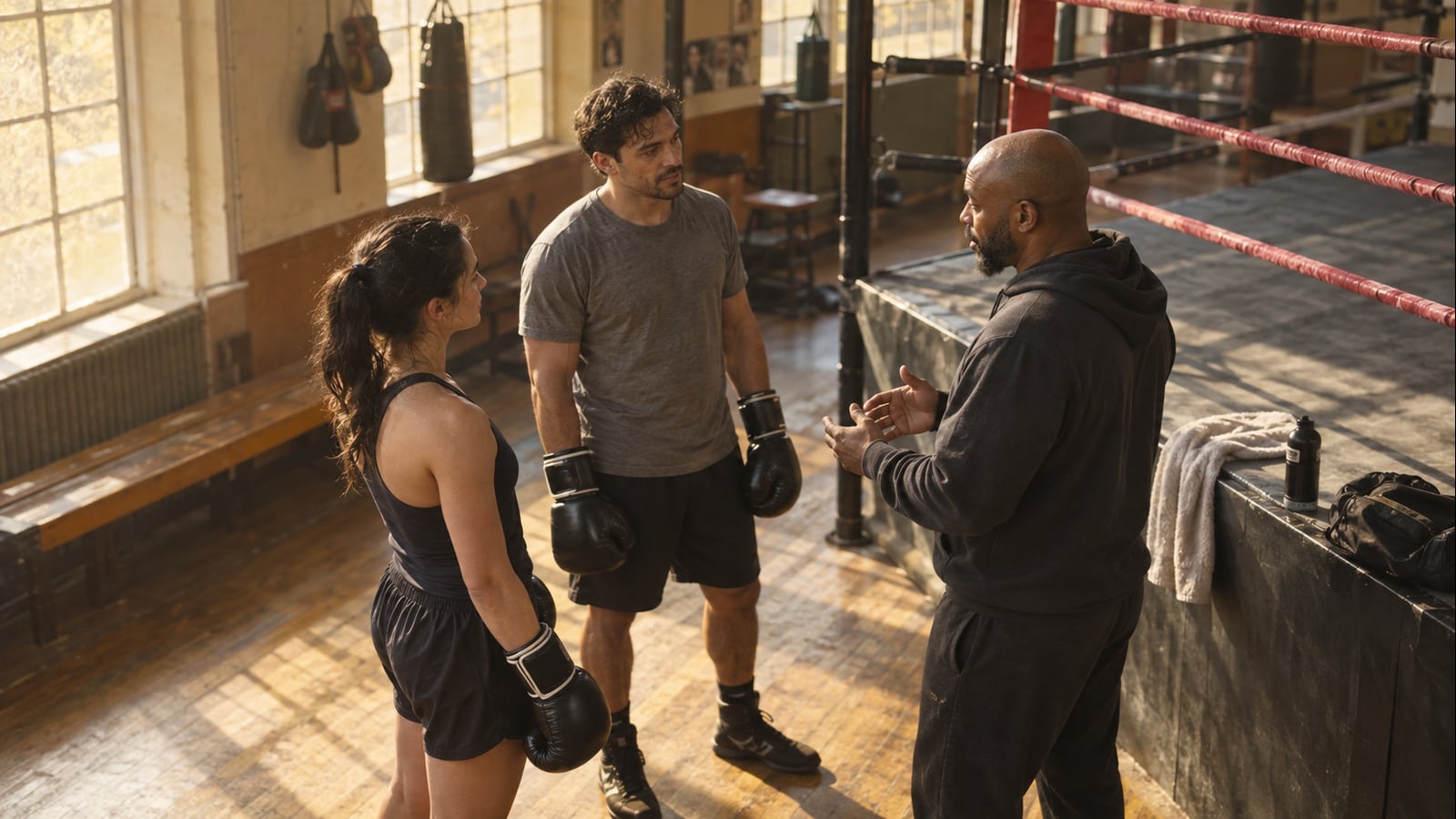
Ask your coach to show one cue associated with a defense you have already learned. Start outside contact range, with a deliberately controlled demonstration and a full reset between attempts.
Your job is to notice the cue and reproduce the agreed action—not beat a speed record. For a hand defense, the coach can first check the shape without impact. For a movement defense, they can check whether you finish balanced and able to see them.
After an attempt, answer one question: “Did I respond to what I saw, or move because I expected the next repetition?” It is useful to discover that you were starting early. That is information about the task, not a reason to make it harsher.
This example isolates a cue. It does not reproduce the decisions of open sparring.
Practice idea two: keep the cue, vary its timing
Once the first task is understood, discuss changing only when the cue appears. Keep the action and limits agreed. Your coach can pause, present the cue, or reset without giving it.
Now the question is whether you wait for relevant information rather than perform a memorized rhythm. When there is no cue, there is no obligation to invent a defense just to look busy.
Use a simple debrief: “I moved early,” “I recognized it but rushed,” or “I did not know what I was looking for.” Those observations suggest different adjustments. Asking the coach to demonstrate again may be more useful than doing another rushed set.
Practice idea three: add a small decision
The next discussion is about a limited choice—not suddenly allowing everything. The coach might present either the familiar cue or a clear reset signal. Later, they can decide whether another already-taught response belongs in the task.
England Boxing's sparring resource describes adjusting constraints such as task, speed, space, and pressure. Use that principle to ask for one clear change rather than making every part harder at once. [2]
Do not assume more unpredictability requires harder punches. The learning question here is whether you select appropriately. If you cannot explain the choices, simplify the task before attempting to perform them faster.
Add the next action without turning it into a flurry
A defensive drill needs an ending. You might reset your stance, move to the agreed position, or use a simple follow-up the coach has already taught.
Sands' Reactive Strike drill connects a hand defense with a follow-up, rather than treating the defensive action as the end of the exchange. [4] For an introductory version, discuss finishing with a controlled touch to a pad target—not an automatic counter to your partner's face.
The question becomes: “After defending, am I somewhere useful?” A movement that technically avoids the demonstration but leaves you facing away or unable to reset needs attention too.
Stop making head movement a fixed dance
Suppose you always move left, right, then stand still. You may know the sequence perfectly while still being unsure which part relates to the situation in front of you.
Rather than adding a longer pattern, ask your coach to review one moment: “What was this movement meant to avoid or create?” This is a way to examine predictability, not a claim that all planned movement is wrong.
Try a video-review question, with permission to record: “Did I react to something, deliberately create something, or simply repeat my usual pattern?” You are looking for a purpose, not proof that your head moved enough.
Do not practise unpredictability by throwing your head around at random. Ask for an appropriate response to a specific cue, and keep the size and direction of the movement within what your coach has taught.
What to practise on your own
Use a mirror or a short recording to inspect one known movement. Choose a single checkpoint—such as returning a hand to its starting position—and avoid turning the review into an attempt to diagnose every technical detail yourself.
A possible solo session has three small pieces: rehearse the action, connect it to a familiar step, then write down one question for your coach. There is no need to pretend the imaginary opponent has validated your timing.
Knockout can support independent fundamentals practice. Live defensive decisions still need feedback and appropriately supervised partner work; the app does not reproduce an opponent. [5]
Related questions about boxing defense drills
Can I improve boxing defense without open sparring?
You can rehearse movements and use coach-led, constrained practice without jumping straight into open sparring. Be precise about what each task tests. A predictable drill can help you work on one component without proving you can handle unrestricted exchanges. [1][2]
Do tennis-ball drills prove I have fast boxing reactions?
They show how you perform the particular ball task. This guide does not establish that a better catching score transfers to recognizing punches. Use boxing-relevant cues with a coach to assess that separate question, rather than treating a gadget result as contact readiness.
What is a sensible first defensive drill to ask about?
Ask for one defense you have already been taught, paired with one clearly demonstrated cue. Begin with non-contact rehearsal and a clear reset. Let the coach choose the actual movement and conditions after seeing your current ability.
How do I stop moving my head predictably?
Review the purpose of a specific movement before adding more moves. Ask whether you were reacting to a cue, creating a response, or repeating a habit. The answer may call for a simpler task, not a faster or larger sequence.
Should every defense be followed by a counterpunch?
No single follow-up belongs in every situation. A drill may deliberately include a counter, but another may end with a positional reset. Agree on the task with your coach instead of turning every practice defense into an uncontrolled exchange.
How will I know a reaction drill is helping?
Record a narrow observation: recognizing the agreed cue, avoiding an early guess, or finishing in the intended position. Recheck it with your coach when the task changes. Do not turn improvement in a drill into a guarantee about open sparring.
Sources and scope
The questions behind this guide come from Knockout’s saved Reddit research. Coaching and safety claims were checked separately against the sources below. The sample questions, worksheets, and practice examples are editorial suggestions—not tested protocols or individual clearance to take part in contact boxing.
[1] Fran Sands / MyBoxingCoach. Boxing Drills — Boxing Training.
https://www.myboxingcoach.com/boxing-drills-boxing-training/
[2] England Boxing. Sparring Resource (2021).
https://www.englandboxing.org/wp-content/uploads/2021/07/Sparring-Resource-Final.pdf
[3] England Boxing. Boxing Coaching Handbook, Part 1. Coaching principles and specified technique faults only; use current rules for eligibility and equipment.
https://www.englandboxing.org/wp-content/uploads/2022/03/EB_Boxing-Coaching-Handbook-Part-1_v8-002.pdf
[4] Fran Sands / MyBoxingCoach. The Reactive Strike Boxing Drill.
https://www.myboxingcoach.com/the-reactive-strike-boxing-drill/
[5] Knockout. Knockout — Boxing Training.
https://www.knockoutboxing.app/