You do not need to walk into your first boxing sparring session feeling fearless. You do need to know what you have agreed to do, who is supervising, and how the session stops.
Readiness is not a number of weeks on a calendar. Discuss it with a qualified boxing coach who has watched you train, and meet the medical and registration requirements that apply to your club. An article, a fitness test, or finishing an app program cannot make that decision for you. [1][2]
Perhaps your combinations feel comfortable on the pads, but the idea of another person punching back changes everything. Start with a conversation—not a promise to survive whatever happens.
Ask what “sparring” means today
The word can describe different activities. England Boxing distinguishes technique sparring, conditioned sparring, and open sparring. They differ in how tightly the task is controlled and how much choice the boxers have. These are coaching tools, not three levels you must race through. [1]
Instead of asking only, “Are we going light?”, ask: “What can each of us do, and what am I practising?” A useful answer identifies the task, allowed actions, intended contact, and how the coach will intervene. Do not assume another person's idea of light contact matches yours.
Here is an example of the clarification you are looking for: “Is this a controlled practice of the defense we learned, or can my partner use any punch?” That question is useful before you put your mouthguard in.
Have the readiness conversation before the gloves go on
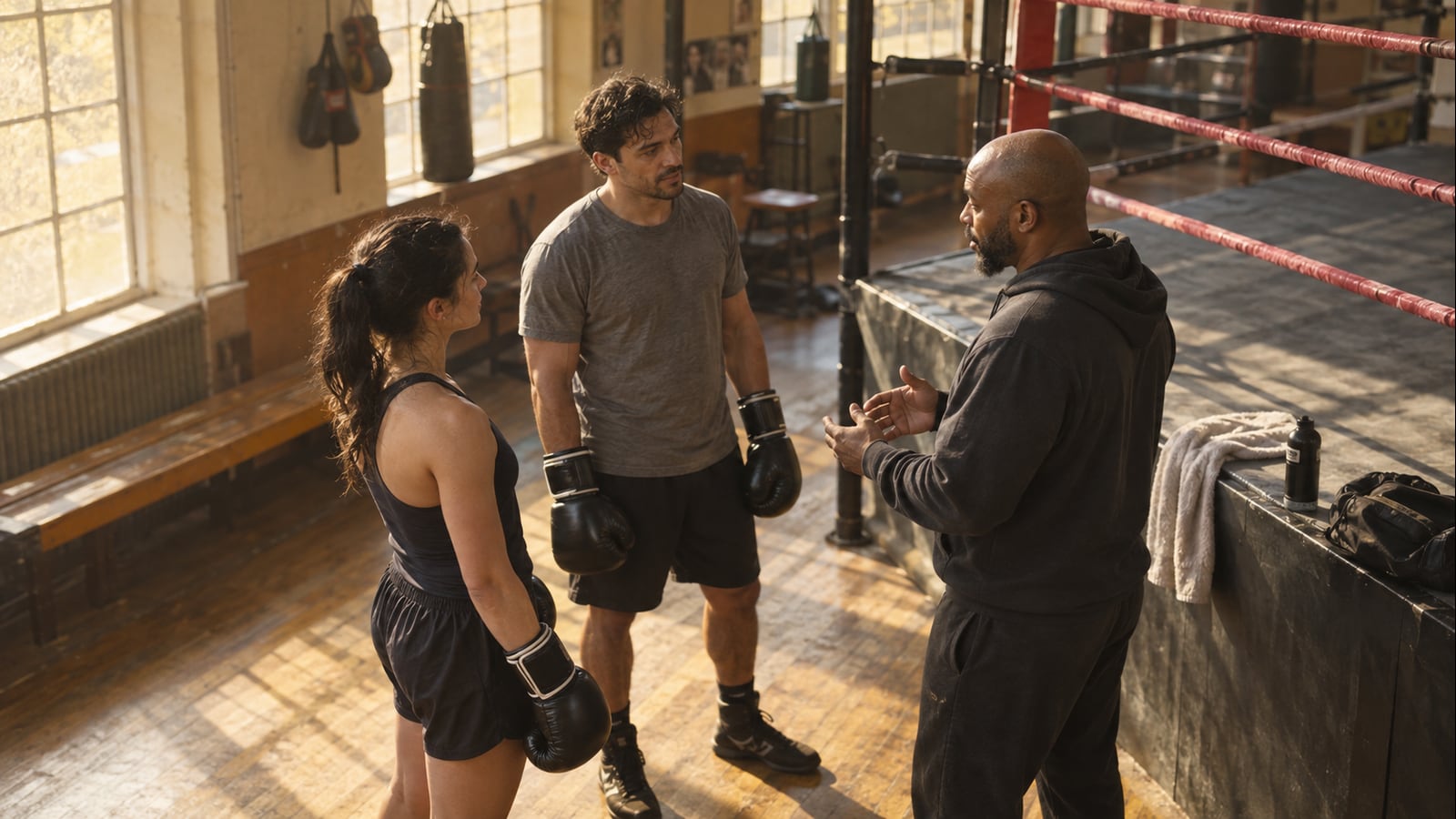
Ask your coach what they have observed—not just whether you look keen. Which skills are reliable in partner practice? Which still break down? What would they like to see before adding more uncertainty?
Make your own concerns specific. “I lose my balance when I retreat” gives your coach something different to assess than “I am nervous.” “I have not practised that defense with a partner” is important information, not an embarrassing confession.
Medical clearance and coaching readiness are separate. As one jurisdiction-specific example, England Boxing's 2026 rules require an appropriate medical before first sparring and supervision by an actively licensed Level 2 coach. Other governing bodies have their own requirements; your club should establish which apply. [2]
Do not hide a recent injury or symptoms because you do not want to lose your turn. And you can decide that you prefer non-contact boxing. Sparring is not something you owe the room.
Get clear answers to these five questions
Who is my partner, and why are we matched? Ask the coach about the pairing. Appropriate matching involves more than finding someone available; England Boxing's handbook includes development, experience, weight, and height among the considerations. [3]
What is my one task? “Practise the defense we just worked on” is easier to discuss afterward than “try to be good at sparring.” The coach should choose a task suitable for both of you.
What are the limits? Clarify permitted actions, contact, duration, and rest. A vague percentage of power is not the entire agreement. Ask what the coach wants to see and what will trigger a pause.
Who is watching? Know which coach is supervising and how to get their attention. Do not treat a training partner as a substitute for the required supervision.
What happens when either person says stop? There should be no negotiation during continued punching. Both people stop, and the coach addresses the problem before deciding what happens next.
When you feel nervous, ask for something concrete
Try: “I want to try this, but I am worried I will panic when the pace changes. Can we go through the task and stopping signal once more?”
Or: “Could I watch an example first, then rehearse the same situation without contact?”
These are requests for clarity, not guarantees that nerves will disappear. You do not have to talk yourself into enjoying uncertainty before you are allowed to learn.
You can also separate two concerns: “I feel unfamiliar with this” and “I do not trust these conditions.” Do not use the first explanation to dismiss the second. An unclear task, ignored stop request, or unwanted escalation needs action—not a motivational speech.
Too tired to defend? Stop the round
When fatigue leaves you unable to protect yourself or follow the task, tell the coach and stop. England Boxing's coaching handbook advises stopping sparring when fatigue sets in. There is no useful prize for staying in while your defense disappears. [3]
“I cannot defend properly; stop” is enough. Do not search for a clever tactic that makes continuing acceptable. The coach can review the workload and conditions afterward. First, end the exposure.
Being overwhelmed is also a reason to pause. Do not wait until you have decided whether the cause is fitness, confusion, fear, or all three.
Review the first session without putting yourself on trial
“I was terrible” does not tell you what to practise. Use three separate questions when you speak with your coach.
What happened? Describe one observable moment: “When the jab came, I closed my eyes and stopped moving.” Avoid turning one moment into “I am not made for boxing.”
Were the conditions appropriate? Did the agreed task stay intact? Was the pace manageable? Did your partner and coach respond when you needed a pause? A bad experience is not automatically a necessary initiation.
What is the next practice task? Ask for one manageable correction and the setting in which to practise it. The next step may be a simpler partner drill rather than more open sparring.
This is a suggested reflection format, not a test you pass. You can learn something useful and still decide that you do not want to repeat the session as it was run.
Your first bout is a different conversation
Being able to take part in a controlled learning session does not establish competition readiness. Discuss preparation, matching, medical eligibility, and the relevant competition rules separately with your coach. England Boxing's 2026 rules, for example, include an additional pre-bout sparring requirement; that is not a universal timeline or an automatic permission to compete. [2]
Do not choose a fight date simply to make yourself feel committed. A better question is: “What would need to be true before entering a bout is appropriate for me?”
Keep solo practice in its proper role
Knockout can support independent practice of fundamentals. It does not assess contact readiness or replace the coach supervising sparring. Use it to revisit an appropriate skill—not to unlock permission to fight. [7]
Questions beginners ask before sparring
How long should I train before my first sparring session?
There is no universal number of weeks that establishes readiness. Ask a qualified coach to assess your preparation and planned task, and check the applicable medical and registration requirements. Someone else's first-sparring date is not your deadline. [1][2]
Can I learn boxing without sparring?
You can choose non-contact practice and work on fundamentals. Be honest about that goal: rehearsing movements is not the same experience as applying them against a responsive partner. You do not have to pursue contact boxing to justify enjoying training.
What should I say when I am nervous about sparring?
Name the part that worries you: contact, pace, unfamiliar defenses, or not knowing when you can stop. Ask the coach to explain or simplify that part. “I need a clearer plan before I agree” is a reasonable starting point.
Was my first sparring session supposed to feel awful?
An unfamiliar task can expose things you have not practised, but that does not make humiliation, ignored boundaries, or injury an acceptable teaching method. Review the conditions as well as your skills. Discuss symptoms after a hit with a healthcare professional, not only your coach. [4][5]
Does wearing headgear make sparring concussion-proof?
No. Protective equipment is not a guarantee against concussion, and a headguard does not make harder contact automatically acceptable. Follow the equipment rules that apply, but do not confuse meeting those rules with removing the risk of injury. [6]
When can I enter my first boxing bout?
That requires a separate discussion with your coach and the relevant governing body. Training experience, appropriate matching, and medical and competition eligibility all matter. Completing your first sparring session does not settle those questions. [2]
Sources and scope
The questions behind this guide come from Knockout’s saved Reddit research. Coaching and safety claims were checked separately against the sources below. The sample questions, worksheets, and practice examples are editorial suggestions—not tested protocols or individual clearance to take part in contact boxing.
[1] England Boxing. Sparring Resource (2021).
https://www.englandboxing.org/wp-content/uploads/2021/07/Sparring-Resource-Final.pdf
[2] England Boxing. England Boxing Rule Book 2026, version 26.2, section 5.7. England Boxing rules only; check your governing body and club before participating.
https://www.englandboxing.org/wp-content/uploads/2026/01/EB-RB-26.2.pdf
[3] England Boxing. Boxing Coaching Handbook, Part 1. Coaching principles and specified technique faults only; use current rules for eligibility and equipment.
https://www.englandboxing.org/wp-content/uploads/2022/03/EB_Boxing-Coaching-Handbook-Part-1_v8-002.pdf
[4] Centers for Disease Control and Prevention. Responding to a Sports-related Concussion.
https://www.cdc.gov/heads-up/response/index.html
[5] Centers for Disease Control and Prevention. Signs and Symptoms of Concussion.
https://www.cdc.gov/heads-up/signs-symptoms/index.html
[6] Centers for Disease Control and Prevention. Preventing Concussion.
https://www.cdc.gov/heads-up/safety/index.html
[7] Knockout. Knockout — Boxing Training.
https://www.knockoutboxing.app/